
Medievalish 4.10
The Invitations of Parchment

Dear friend,
It’s October, and I usually write a Memento Mori (here) or All Saints’ (here) post at this time of year. I hate the creepier decorations, but love the silly invitation to remembering death in a non-frightened, lighthearted way that all the skeleton decor offers out. But today, I am thinking of something a little different.
Memento mori—remembering your own fleetingness, impermanence, mortality—is one of the acts of the Christian life. This remembrance keeps us tethered to our bodies and limitations. But paradoxically, this tethering is freeing. We are not God. We do not rule the world. We can’t even rule ourselves. So lean in to your fundamental belovedness and need. Welcome the need and belovedness of others.
Medieval people were very good at remembering their deaths. Death had not yet been sanitized and sequestered to nursing homes and hospitals. Death happened in ordinary homes on ordinary days. There was no fantasy of escaping aging through Botox or biohacking.
Today, the most counter-cultural practice of memento mori is the claim that the limits of bodies are a gift, not always (maybe even rarely) a curse.
I have been thinking about limitations in a roundabout way. Last spring I had the great privilege of visiting the British Library and the Bodleian Library at Oxford. I’ve written about this trip a couple of times already, because it was the culmination and expression of many dreams and joys. I will never forget examining the sole known copy of Margery Kempe’s writings. I thought that I could die a happy woman at my little desk in the British Library while looking at the oldest complete copy of Julian of Norwich. I am not being facetious. It was one of the best days of my life. I was trying very hard not to be a ridiculous and hysterical American. Do not weep and horrify the stern librarians and all the old British professor-types studying around me, I kept saying to myself.
The impact of that trip is still sinking into my heart and mind. But one of the things that has stuck with me is the feel, texture, smell of reading handwritten parchment. I only had three mornings at the British Library, and only one full day at the Bodleian. So I had stacks of manuscripts, taking three at a time, from a list that felt dreamlike when I was composing it. All of a sudden, all was real. Each scribe’s varying hand and conventions, each different pen, changing textured animal skin, and of course the content, the paragraphs and all the little scribal mistakes and doodles and manicules pointing towards something important, all color and fulfill the reading and thinking experience. Generalities do not exist, really. Only particulars.
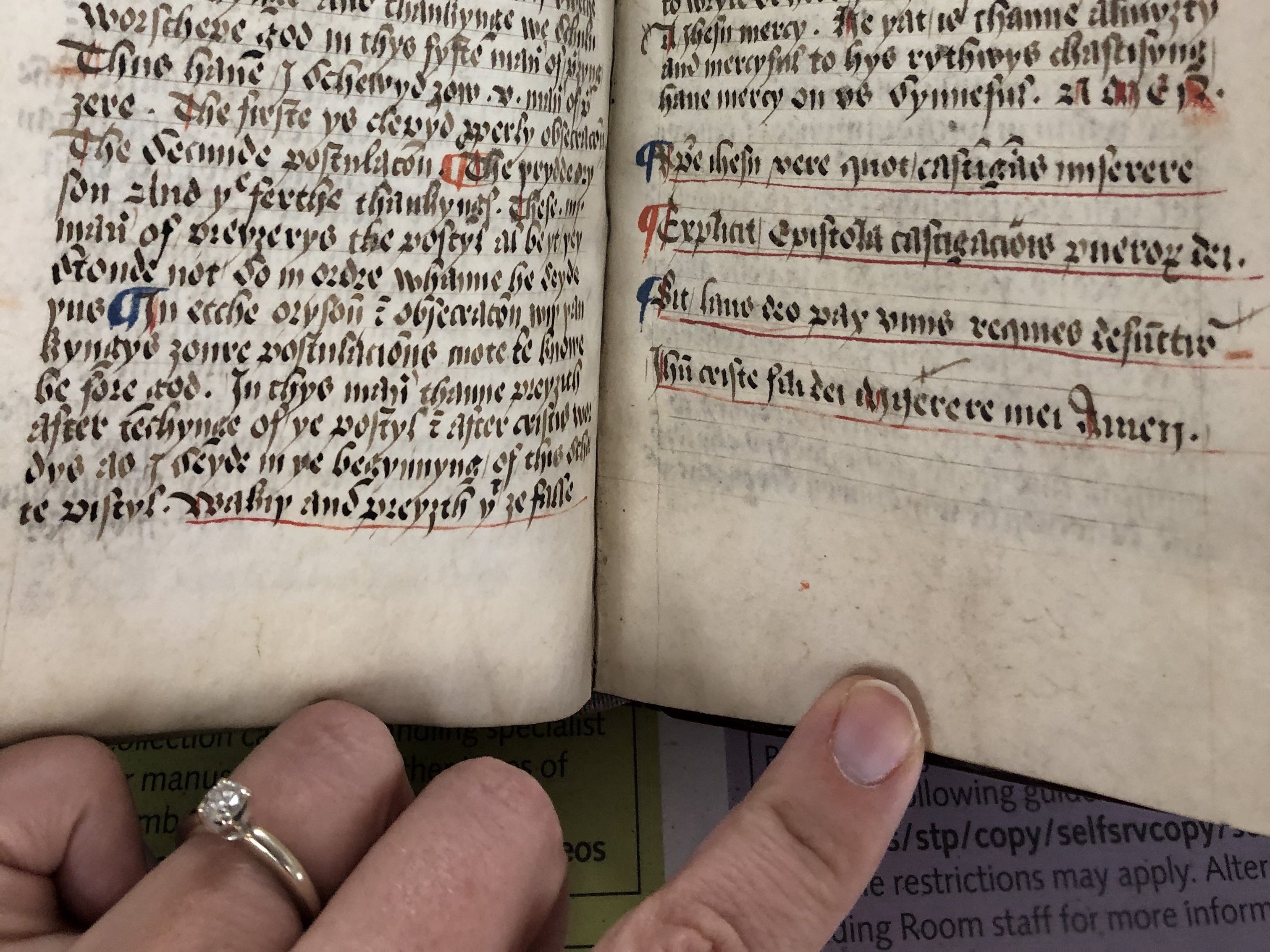
There is a lovely book by the great book historian and librarian Christopher de Hamel, Making Medieval Manuscripts. In it, he goes step-by-step through the process of making a book. Not writing it, making it. On one page, an animal is slaughtered and skinned, and the hairs are being stripped off an animal skin. Then, the skin must be stretched, painstakingly. And so on—until a piece of parchment is created.
Then, de Hamel turns to the making of ink. Gall ink comes from where oak trees have bubbled up a sort of tree blister in response to a wasp laying its eggs in its bark or leaves. One must harvest the galls and prepare a recipe for the ink with iron and other materials.
And then, of course, a scribe must copy the words at hand. I could see where a scribe’s hand began to tire and get a little scribbly, or where they had to change their ink. What a laborious task, to hand-write an entire copy of Thomas Aquinas’s Summa Theologiae or Geoffrey Chaucer’s The Canterbury Tales! I have to snicker at the words of a scribe who copied St. Thomas and then wrote on its final page that it was the “longest, most extensive, and most boring to write: Thank God, thank God, and once again thank God.”1
At last, one mustn’t forget the illuminations for the most costly and time-intensive books. Each color of ink required a different process, collecting, harvesting, shipping rare and expensive stones or shells or other things to make the heavenly azure of the Virgin’s robe or the viridescent emeralds and fiery vermilions of draping robes or the golden, lightbound haloes of the saints.
I do tend towards being a Luddite, but I wouldn’t want to return to this style. I’m very thankful for the printing press, and mass communication, generally speaking.
But all this labor has struck a trembling note deep within me. I have been thinking about my language in a new way. I wonder how much these natural and laborious limits of manuscripts made for a much deeper intentionality. How much more I would think about my language if I knew another human was etching it into the skin of an animal with the ink of irritated trees, and then even setting it alight with the jeweled flame of illumination. Reimposing limitations on my falsely limitless world of writing would be a good. I think it would be good for all of us. For how often do I casually drop careless words, in posts and notes and comments to my children or husband?
Your words, and mine, are a precious resource. It does not do to forget this. Language is a gift. Medieval theologians believed that the power of the word was one of the ways we are made in the image of God. If Christ is the Word made flesh, with each word, we can imitate him or destroy another image-bearer.
In this particular moment, one pointed call for Christians is to be ever more careful and tender and attentive with our language and our silence. Let us attend to its power to cut and power to heal. Let each syllable become a vehicle for love in cutting and healing, less like a fistfight and more like a surgeon cutting out tumors and stitching wounds closed. Lean into the limits and silences. Let our words be worthy of a manuscript page.
What I’ve been up to this month:
I shared about one of my favorite mystical writers, the bizarre, joyful, and glorious Thomas Traherne, for Plough.
Book launch things! Highlights include interviews with The Holy Post, The Alabaster Jar, the Intervarsity Women Scholars & Professionals podcast, a fun and different interview with Rapt, a review by Amy Mantravadi for Mere Orthodoxy, a new and notable books mention in First Things, and more coming down the pipeline.
Old Books with Grace is back! I welcomed the brilliant Professor Rebecca Konyndyk DeYoung, author of Glittering Vices and one of my scholarly heroes, last week. And despite technical difficulties and many emails with Apple Podcasts, it is finally up on that platform. Next week, the marvelous Jessica D. Ward of Middle English Delights will join me for a Chaucer episode! Listen on Apple, Spotify, or wherever you get your podcasts.
What’s next:
In November, I have the privilege of speaking at Awe & Presence with The Living Church alongside Malcolm Guite, W. David O. Taylor, Abram Van Engen, and Matthew Olver. I’ll be teaching on one of my favorite things: medieval art and poetry of Mary in the Annunciation, and what she models for us about worship and encountering God. Meet me in St. Louis (anyone else hear Bugs Bunny sing this, and not the musical?), Nov. 6-8. Get more information and register here.
What I’ve been reading this month:
Nonfiction: Richard Foster’s Prayer. Underlining and highlighting every chapter.
Fiction: I have been slowly, delightfully rereading and savoring The Lord of the Rings. Nothing like comfort rereading during a season of stress. Right now, Frodo and Sam have just met Faramir for the first time (and though I truly do love the movies, I’m still grieving over what they did to Faramir’s character!).
Medieval/Medieval-adjacent: Still soooo slowly working my way through Walter Hilton. Book launch season hollows out my reading abilities.
Article: Two reviews, one of a book, one of art. From the London Review of Books, on my perennial obsession, the Pearl-Poet. From the New York Times, a massive show of Fra Angelico in Florence (if I could grow wings, I’d immediately fly to this one).
A Prayer from the Past
As we move into the season of darker nights and mornings, I think a prayer for the night is appropriate. This one is from Lewis Bayly, Puritan Bishop in the Church of England (d. 1631). His book, The Practice of Piety, directing a Christian how to walk that he may please God, was one of two books that catalyzed the intense conversion of John Bunyan, author of Pilgrim’s Progress. This prayer is excerpted from Piercing Heaven: Prayers of the Puritans edited by Robert Elmer (Lexham Press, 2019).
Set apart to me this night’s rest, Lord, that I may enjoy your sweet blessing and benefit.
With this refreshing sleep, enable me to walk before you, doing the good works you have appointed. And while I sleep, you who are the keeper of Israel, you who neither slumber nor sleep, watch over me in your holy providence.
Protect me from all dangers, so that neither the evil angels of Satan nor any wicked enemy may have any power to do me harm. Let your holy angels pitch their tents around me, for my defense and safety.
Knowing your name is a strong tower of defense to all who trust you, I commit myself and all that belong to me to your holy protection and custody.
And if it is your will to call for me in my sleep, Lord, have mercy upon me, and receive my soul into your heavenly kingdom.
But if you are pleased to add more days to my life, make those days even better than before. Wean my mind from the love of the world and worldly vanities, and cause me more and more to talk about heaven and heavenly things.
Perfect in me every day that good work which you have begun, to the glory of your name and the salvation of my sinful soul. Amen.
Peace for your October,
Grace
P.S. Medievalish is free, and I’d be delighted if you shared it with a friend!

Christopher de Hamel, Making Medieval Manuscripts (Bodleian, 2018), p. 93, manuscript is New College MS 121, fol. 367v, England, early fourteenth century.
I love this. I decided to hand-write in calligraphy two things; a personal prayer book and the Little office of Our Lady in the Sarum rite (which isn't printed anywhere really). Yes, you can see when I got tired, and the problems I had with the pen I used at the start. The quality is variable and some of the lines are wonky, but these two things are unique and also an expression of devotion - which is just what those medieval scribes had, to write so many pages!
I'd forgotten, but traditionally Benedictine novices are required to write out the Rule during their novitiate. The act of copying brings you closer to the source.