
Medievalish 5.5
The Cloud of Unknowing

Dear friend,
During my undergraduate and masters degree years, I found many, many gems at the absolute best used bookstore—the Bookmans on Grant and Campbell in Tucson, Arizona, where many professors from the university would sell their books when they retired. It remains the bookstore of my dreams. It was in a hideous, boxy building that smelled of mildew, next to a rundown Walgreens that was perpetually being robbed. And it was chockfull of delight. Rest In Peace, Grant & Campbell Bookmans. Thriftbooks, you know I love your rewards program, but you can never compare.
One of these treasures was a scruffy little Penguin Classics paperback translation of The Cloud of Unknowing. It was $1.50. Talk about an investment. I bought this before I became a medievalist. It was both one of the first Middle English works I read (outside of Chaucer, of course) and one of the only Middle English works that I first read in translation rather than in the original. And now, as a result, I have a strange attachment to reading this one in translation, rather than my usual insistence to go to the Middle English. The Penguin is introduced and translated by Clifton Wolters, in a charming midcentury style.
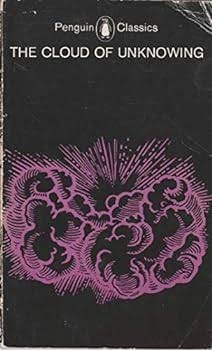
The Cloud of Unknowing is a fourteenth-century guide to learning how to pray without the inevitable mental images we have of God, and with as few words as possible. Its author was a contemporary of Richard Rolle, Walter Hilton, and Julian of Norwich herself, in the flowering of late medieval contemplative writing happening in the devastating wake of the Black Death and ongoing Hundred Years War. As translator Wolters notes, “It was in this restless, unsettled age that mysticism revived, and men turned from the rage and storm to consider rather the calm depths that lay beneath.”
Cloud was written by a priest, but we have no idea of his name or context. He was interested in the branch of learning to know God called the via negativa, or the apophatic way. The other main way is the via postiva, or the cataphatic way. Both ways agree that God is ultimately uncapturable by our human language. But they have different ways of expressing this idea: the positive way says we know through our senses, and we can capture bits and pieces of the divine through creation. Julian of Norwich, for instance, is a cataphatic mystic, piling on metaphors and images in order to begin to gesture towards the God wholly beyond and wholly good. The apophatic way rejects images and words in order to begin to know God. This is the way of the Cloud writer, who famously argues that we all must enter into the “cloud of unknowing,” shedding all the ways we have tried and failed to explain and encompass the Godhead, before we can even catch glimpses of Him. Love does not come through knowledge, but through knowing how little you know, straining towards Love Divine, all other loves excelling. The Cloud of Unknowing is a treatise on how to pray like this.
The Cloud of Unknowing is written for someone following a vocation into the contemplative life. In the fourteenth century, there existed a strong division between the active life (basically everyone who is not a monk or nun or hermit or anchorite) and the contemplative life (those people). Some thinkers of the time, like the mystic Walter Hilton, were trying to write a way in-between these, for lay folk who couldn’t enter a monastery but desired to learn the ways of contemplative prayer. The Cloud of Unknowing does not believe such a path is possible, but nonetheless, remains powerful even for those of us who are not solitary recluses in the religious life. It reminds us how God always is the one who welcomes us—we are never going to pray ourselves into holiness with concerted effort. God waits for us, invites us, changes us himself, only with our consent and longing. Prayer looks so often like listening and waiting and trying to move aside our preconceived notions about what should be happening (or even who God is).
The Cloud author is practical and at times even funny. He writes bangers like this line: “Lift up your heart to God with humble love: and mean God himself, and not what you get out of him.”1 But in order to increase this longing, we must enter the “cloud of unknowing, where we wait for God in our utter ignorance and littleness. This is basically the entirety of the book summed up—and yet of course it cannot do it justice.
The first time I read Cloud, I was twenty-four years old, married a year, at the beginning of my second year of teaching and graduate school, quite lonely. I would get sick in the bathroom before every class I taught because I was so nervous. I had a blog back in those days called Literary Musings, that approximately seven generous people read. And here’s what I wrote at that time part way through reading The Cloud of Unknowing:
So far, the book has spoken of being solitary, and being 24 years old--I’m not kidding, it literally said 24 years old--and feeling altogether dry and unable to spiritually connect, due to an inability to reach God with our own power, intellectually or any way. Was this book written with me in mind, 650 years ago?!
However, the prayer beginning the prologue, and the appeal to the reader beginning the actual book, have been the most meaningful to me thus far. I want to share them with you. First, let’s look at the appeal.
“I earnestly beg of you to look most attentively to the way and the method of your vocation. And give God heartfelt thanks, so that you, by the help of his grace, may stand without flinching in the state, and stage, and manner of life that you have wholeheartedly entered upon, against all the wiles and assaults of your physical and spiritual foes, and may win through to the crown of everlasting life.” (50)
Now, a vocation is a spiritual calling to a special work, but also, a “natural fitness or tendency for such work” (Oxford). Many, many of us struggle with a desire to find our vocation or fear that we won’t find it, if such a thing is possible to “find,” or feel as though what we currently do does not fill that vocation, or worry about that calling from the Lord because of its uncomfortable qualities or that it won’t be “right” for us. But--and the word itself, by its definition, tells us this--the Lord both calls us to things, and makes us fit for the things that he calls us to. The author of The Cloud of Unknowing is right in praying and begging for us to keep an eye on our vocation. I worry about mine all the time. I want to write. I also feel like the Lord calls me to it. But then I also feel in different (mainly insecure) moods and moments that it is manifestly impractical, a pipe dream, or an arrogant desire for recognition. I can be my own foe, as well as having outside enemies. But here is the author’s appeal, and our prayer: that we may pay attention to our vocation, give thanks for it, and then, “stand without flinching” in that place, wholeheartedly entering into that calling. Pay attention, give thanks, and go forth. That is our job.
Funny to see these words written about twelve years ago, before I got my doctorate, before I wrote any books. A good and encouraging note today for me: Keep paying attention, keep giving thanks, keep sallying forth. I’m sure that the Cloud author, devoted to the contemplative life in its fourteenth-century form, never in a thousand years dreamed he’d be encouraging a mom of three, a contemplative-wanna-be living a very active life, across an ocean six and a half centuries later. Isn’t that just amazing about reading old books?
I heartily recommend the slightly old-fashioned and highly readable Penguin Classics translation by Wolters, but if you want to give the Middle English a try, there’s a TEAMS edition available online. There’s also a Penguin Classics edition edited and translated by the always brilliant A.C. Spearing, alongside other Middle English works of the via negativa.2
What I’ve been up to this month:
Writing and researching.
Wonderful teaching times in Denver. Wrapped up my speaking “season” for the spring.
Old Books with Grace featured Mischa Willett on Samuel Taylor Coleridge in a delightful conversation. I’m going to leave the podcast alone for the summer now. If you enjoyed this season (or this newsletter), I’d always appreciate donations for the hosting fees so that I can continue to keep it ad-free!
What’s next:
Glorious, glorious summer! Summer is always a time of beautiful focus for me of early morning writing, weeding my massive, always somewhat dying vegetable garden, swimming at the neighborhood pool, and general play with my kids. No other things on the horizon until the fall, where I resume teaching in places like San Diego, Dallas, and Georgia.
What I’ve been reading this month:
Nonfiction: James K.A. Smith ’s new Make Your Home in this Luminous Dark. I had the privilege of hearing Dr. Smith speak last week here in Denver and it was invigorating and delightful. I look forward to reading this one. It is also about the Cloud!
Fiction: Been re-reading George MacDonald’s novels. Just did his Thomas Wingfold series. I think about it a lot. No one does spiritual transformation quite like MacDonald. And it’s so fun to see how Lewis embraces so much of MacDonald’s original ideas. I love a good literary forebear.
Medieval/Medieval-adjacent: Back to Walter Hilton’s Scale of Perfection! (Is he the new Piers Plowman in my life, the book I continually read verrrryyy slowly for years and years just in different translations and editions?)
Article: An interesting meditation on billionaires from The Atlantic… “everything is free and nothing matters.”
A Prayer from the Past
Cloud of Unknowing opens with the Middle English version of a prayer now best known as the Anglican Collect for purity. This prayer was first composed in Latin in the 10th century. Thomas Cranmer translated it for the 1549 Book of Common Prayer, and now it appears in varying English prayer books for many different denominations and traditions.
God, unto Whom alle hertes ben open, and unto Whom alle wille spekith, and unto Whom no prive thing is hid: I beseche Thee so far to clense the entent of myn hert with the unspekable gift of Thi grace that I may parfitliche love Thee, and worthiliche preise Thee. Amen.
Peace for your May,
Grace
P.S. Medievalish is free, and I’d be delighted if you shared it with a friend!
p. 53 in Wolters, ed. Cloud of Unknowing.
This post first appeared over two years ago for paid subscribers only, before I stopped doing paid subscriptions. Enjoy!
I love this so much! Today I noticed a MacDonald reference in Emily Climbs by L. M. Montgomery: "I would like to get into a ship and sail straight out there—out—out—where would I land?...Some beautiful unknown shore where 'the rain never falls, and the wind never blows.' Perhaps the country back of the North Wind where Diamond went. One could sail to it over that silver sea on a night like this." Never noticed that connection before!
Love the Collect for Purity!