
Medievalish 5.3
Tips on Reading from a Medieval Monk

Dear friend,
The other day I was speaking at a bookstore in Grand Rapids, Michigan. Delightfully, because that is where my publisher is headquartered, the team that worked on Ask of Old Paths all came—my editor, Kyle, my marketer, Alexis De Weese, and my copy editor, Kim. Dream team! Kyle fielded questions during the Q&A and one of my favorite questions was this, basically (I can’t remember his exact words):
What author did you learn to love in the writing of this book?
I know who it was immediately: an author I had never read before tackling Ask of Old Paths, who came up for me in an essay I’d done for Plough PloughStack a couple of years ago. The essay was about Sister Penelope Lawson, the twentieth-century Anglican nun, writer, interpreter, and pen pal of C.S. Lewis. And one of the works she had translated was the Meditations of William of St-Thierry.
One particular joy for me has been discovering medieval writers on my own. Because I did my degree in an English department, I always—obviously—focused on Middle English. I had never read William of St-Thierry.1 So I eagerly picked up Meditations in order to better understand Sister Penelope and fell in love with William. (For the eager reader, here is Sister Penelope’s translation, published by Mowbray in a delightful midcentury book jacket; here is the modern, updated translation by Thomas Davis published by Liturgical Press.) His prayers and meditations on love ended up deeply forming Ask of Old Paths.
William was a part of that twelfth-century monastic revival, and good friends with Bernard. He was born in 1085 in Liege, and became a Benedictine monk (later, he became Cistercian, like Bernard himself). This month, I set myself down to read The Golden Epistle, his letter to novices to teach them the spiritual life (long misattributed to St. Bernard). I did not love it as much as I adored Meditations.2 But I was struck by this passage giving advice on reading and thought you all, as an avid reading crowd, would also enjoy it.
Next, at fixed hours time should be given to certain definite reading. For haphazard reading, constantly varied and as if lighted upon by chance does not edify but makes the mind unstable; taken into the memory lightly, it goes out from it even more lightly. But you should concentrate on certain authors and let your mind grow accustomed to them.3
William is referring to the scriptural reading of monks, naturally. But I love how this idea can expand out into all of our serious reading. William compares reading to relationships, to friendship itself:
There is the same gulf between attentive study and mere reading as there is between friendship and acquaintance with a passing guest, between boon companionship and chance meeting.4
I love this, because it is so true. There are books that are my boon companions, books to which I give a friendly smile and nod on the street, books around which I skirt. Not all books merit the same level of attention.
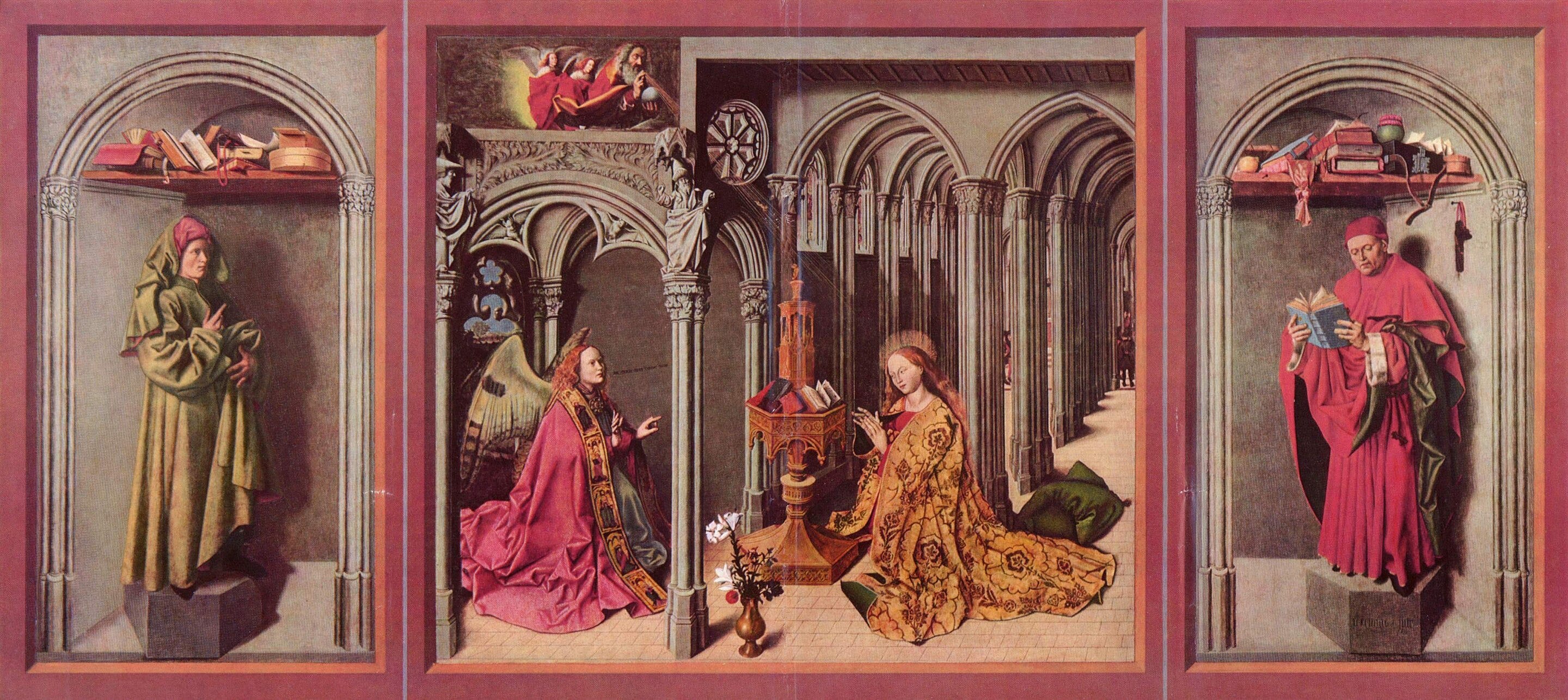
William also argues that some part of your daily reading should also be given over to memorization, for the two complement and inform one another. I am taking this as a challenge. I don’t regularly memorize things in my life, and I think it could add to my deeper friendship with particular books (and especially scripture itself). But memory lends itself to even deeper attention, to continued and ongoing rumination and depth, similar to how the oldest and dearest friend you have has seen you and formed you at different points in your life.
But some interruptions to attention play a profound role in their own right. William does not ask for even the most serious of texts, scripture itself, to possess your whole attention. If you are reading in the love of God, your reading should be frequently interrupted by prayer, as all you read turns you deeper into the life of the Holy Spirit. Such an interruption “should not so much hamper the reading as to restore to it a mind ever more purified for understanding.”5
Reading is profoundly relational. What friendships are you cultivating with books these days? How have you noticed your attention being formed as you read?
What I’ve been up to this month:
Writing and researching :)
Wonderful teaching times in Kalamazoo, Grand Rapids, Colorado Springs, and Houston. I also appeared on the podcast Undeceptions with John Dickson.
Old Books with Grace has a Lent series! The last episode, featuring the delightful W. David O. Taylor on G.M. Hopkins, had a technical difficulty & I had to re-upload it… thankfully easily fixed but if you downloaded it & had problems, try again and it should be fine this time. Oh, the joys of being an idiot at technology who thought it would be a good idea to have a podcast!
What’s next:
Floridians! I’ll be speaking in Gainesville at the University of Florida Christian Study Center on April 9th at 7pm.
Female Denverites: I’ll be speaking at Church of the Ascension’s women’s retreat on April 18th.
Coming up this September: I’ll be leading a workshop on Julian of Norwich and attention at an incredible weekend retreat outside of San Diego with some other brilliant speakers. Check it out.
What I’ve been reading this month:
Nonfiction: Evelyn Underhill’s Mount of Perfection.
Fiction: In between things. What novel should I read next?
Medieval/Medieval-adjacent: More Walter Hilton.
Article: Grotesque Epstein files stuff. I appreciated Katelyn Beaty’s take.
A Prayer from the Past
Today I offer a prayer from E.B. Pusey (d. 1882), tractarian theologian in the Church of England, Regius Professor of Hebrew at Oxford. Found in my trusty Prayers Ancient and Modern gathered and edited by Mary Tileston.
O God, my God, I am all weakness, but Thou art my Strength; I am ever anew bowed down by any trial, but Thou canst and willest to lift me up. Let me not fail, O God, my Strength; let me not be discouraged, O God, my Hope. Draw me each day, if it be but a little nearer to Thee; make me, each day, if it be but a little less unlike Thee; let me do or bear each day something, for love of Thee, whereby I may be fitter for Thee. Let no day pass without my having done something pleasing unto Thee. Thus alone would I live, that I may live more unto Thee; thus would I die, longing to love Thee more—Amen.
Peace for your March,
Grace
P.S. Medievalish is free, and I’d be delighted if you shared it with a friend!
If you’re going to read the twelfth-century monastic writers as a quick taster because really you’re working in the fourteenth and fifteenth centuries in a totally different language, you’re going to read St. Bernard of Clairvaux, not a bad choice either… I’m certainly not complaining there either!
Sigh—there was a bit too much on the ancient monastic tradition of reading the masculine as the intellect or spirit and the feminine as carnal and all the ways to control and subdue the inferior feminine/carnal, one of my least favorite themes of medieval monastic theology.
William of St-Thierry, The Golden Epistle, trans. Theodore Berkeley, OCSO (Liturgical Press, 1971), p. 51.
ibid, p. 52.
ibid, p. 52.
"But memory lends itself to even deeper attention, to continued and ongoing rumination and depth, similar to how the oldest and dearest friend you have has seen you and formed you at different points in your life." - Oh! This is convicting and inspiring for me as well! My daughters just memorized a walking song by JRR Tolkien at their outdoor school and I was overwhelmed with the gift that this is for them now at ages 6&7, but also the rest of their lives!
PS: I heard you speak in Colorado Springs and that was a gift as well! I CANNOT stop talking about Humility to everyone and what I learned in that lecture!
I have always thought of books as I would a good relationship, almost as people. The act of reading becomes, in a certain sense, interactive, especially when I reread a section for better understanding. It came as a surprise to me when I discovered that most folks did not see books that way. Imagine my disappointment.