
Medievalish 5.2
A Call to Charity from Walter Hilton

Dear friend,
Many of our modern favorite medieval writers were hardly read at all in their own time. Julian of Norwich was little known. Margery Kempe only survives in one manuscript, as does the poet of “Sir Gawain and the Green Knight” and “Pearl”. Besides Geoffrey Chaucer, who were medieval English people reading?
One of the most popular writers in late medieval England was Walter Hilton, Augustinian canon and author of numerous English and Latin works of spirituality. Hilton was born sometime between 1340-1345, making him a close contemporary of Julian of Norwich and Geoffrey Chaucer and part of the fourteenth-century flowering of English prose and poetry. We don’t know too much about his life. He was likely a canon lawyer trained at Cambridge, and he died as a member of the religious order the Augustinian Canons at Thurgarton Priory in Nottinghamshire in 1396. (Canons were like monks, living in a community and ordered by a common rule, but not strictly cloistered—they were often clergy and did pastoral work.) Some of his works include The Scale of Perfection, a treatise on the reformation of the soul addressed to a female anchorite; On the Mixed Life, aimed towards laypeople wishing to learn more contemplative prayer; some English commentaries on the Psalms, and many other letters and treatises.
Hilton’s works appear in manuscript collections over and over. The Scale of Perfection proved particularly beloved and was one of the earliest printed books in England, printed by Wynkyn de Worde at the request of Lady Margaret Beaufort, mother of Henry VII.1 But his renown did not survive to the present day. Hilton’s name may be vaguely familiar if you’ve read some of the folks I named above, but it’s likely many of you have never encountered him or his writings at all.
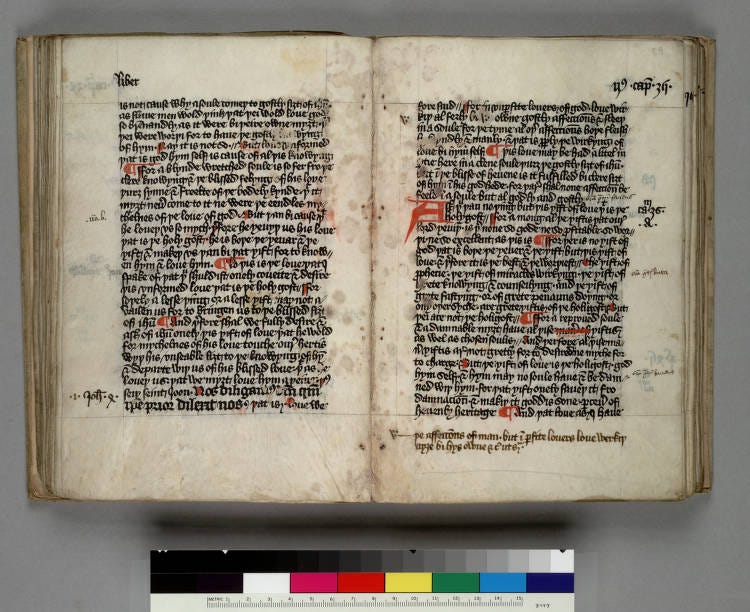
I typically read Middle English works in Middle English, and I read Hilton in my graduate studies in his original language as I prepared for my doctoral exams. But in the early twentieth century, the great mystical writer and teacher Evelyn Underhill did a translation of The Scale of Perfection. I am not only a fan of Middle English spiritual writing, I am a fan of Evelyn Underhill, so I had to read this translation for myself. It was slow, painstaking, and full of wisdom.
Hilton is a pastoral master in Scale. His writing is not as interesting, brilliant, and personal as Julian’s, nor as deep and penetrating as the author of The Cloud of Unknowing. But he is steady and workmanlike in his spiritual guidance, wise and practical. Underhill notes his “gentle realism, that quiet intimacy and simplicity… [his] perfect avoidance of forced contrast and exaggeration.” He is a teacher of the work of keeping the heart, of maintaining and nourishing, attending and listening and transformation: Be thou well quick and ready about the keeping of thine heart! is a paraphrase of many of his sentences.2
Hilton talks often of the need of charity and the temptations away from it when we focus on the shortcomings of others more than ourselves. To hate sin but truly love and adore sinners “is a craft by itself,” worthy of the work of a lifetime.3 We deceive ourselves too often into thinking it is the sin and evil we hate, when really we carry the torch of our hatred for our fellow images of God.
It is no mastery for to wake and fast till thine head ache and thy body weaken, nor for to go to Rome and Jerusalem upon thy bare feet, nor for to start about and preach as thou wouldest turn all men by thy preaching; nor is it no mastery for to make churches and chapels, for to feed poor men and make hospitals. But it is a great mastery for a man to be able to love his even-christian in charity, and wisely hate the sin of him and love the man. For though it be so, that all these deeds before said are good in themselves, nevertheless they are common to good men and to bad, for every man might do them if that he would and had whereof, and therefore to do what every man may do, I hold it no mastery … Love and charity is shed and spread in your hearts by the Holy Ghost which is given to you, and therefore it is the more precious, and the more dainty to come by.4
We are bound to show one another true love and charity, for when you pay attention to your fellow human, think not that you leave God for humans, but rather “if thou be wise thou shalt not leave God but thou shalt find Him and have Him and see Him in thine even-Christian as well as in prayer.”5
This is, of course, the kind of love only available by real, true, repetitive asking, discernment and openness. We often ask for kinds of love that remain closed, exclusive, comfortable (at least, I know I do). My own will is utterly inadequate to love as Christ loves my friends and enemies alike. Hilton insists “there is nothing so hard to get as charity, that is sooth, with thine own travail; and also on the contrary wise, there is no gift of God may so lightly be had as charity, for our Lord giveth no gift so freely nor so commonly as He doth charity.”6 Just lovely.
But how can I know if I am loving others and loving God? This starts in our inner, little, tiny, secret hearts most of all and is revealed by what we attend to, what we listen to, what stirs us and draws our eyes. “For what is a man but his thoughts and his loves? These only make a man good or bad. As much as thou loves God and thine even-Christian and knowest Him, so much is thy soul; and if thou little love, little is thy soul […] And if thou wilt wit what thou loves, look whereupon thou thinkest; for where thy love is there is the eye, and where thy liking is there is most the heart thinking.”7
Hilton is only riffing off Christ here, who said, “Where your treasure is, there your heart will be also” (Matthew 6:21). Where do your eyes land, where does your mind dwell, where does your heart leap or falter? In a time when attention itself has become an economic commodity (a grim reality confirmed by the excess of AI Super Bowl commercials!), who and what will you bestow it upon, give it to, knowing that that is the supreme sign of what you love and desire?
Perhaps this is a good question for Valentine’s Day and then, too, Lent next week. Come, Jesus, with your freely-given charity, and fill our eyes and our ears and our hearts and our fingers and hands and feet up with it so that we may bless our even-Christians and the whole world. Help us to be honest.
What I’ve been up to this month:
Writing and researching :)
Absolutely delighted to hear that my book, Ask of Old Paths: Medieval Virtues & Vices for a Whole & Holy Life, is a finalist for the Dallas Willard Book of the Year, awarded annually by the Dallas Willard Center at Westmont College. I love his book The Divine Conspiracy and feel deeply honored that anything associated with my name might be associated with his!
Old Books with Grace is returning just in time for Lent. Stay tuned for a series on poetry of the past with Lenten themes, with many wonderful guests, wherever you get your podcasts.
What’s next:
People of Western Michigan! Two upcoming events! On February 22nd, I’ll be guest preaching at Southridge Church in Kalamazoo, and after the service, giving a lecture at a Lunch and Learn: “Why should we care about the Middle Ages as Christians?” On Monday, February 23rd, I’ll be speaking and signing books at Baker Book House in Grand Rapids on virtues and vices. Come and visit with me!
On the evening of Thursday, March 5th, I’ll be giving a lecture for the Nicaea Study Center at the University of Colorado, Colorado Springs, on pride and humility in late medieval thought and art. More information forthcoming.
On the evening of Wednesday, March 11th, I’ll be speaking in Houston for St. John the Divine Episcopal Church in their Lent lecture series on prayer. More information forthcoming.
What I’ve been reading this month:
Nonfiction: Finished Richard Foster’s Prayer with my small group. A must-read on prayer.
Fiction: Revisiting Anne of Green Gables. Just what I needed.
Medieval/Medieval-adjacent: Lancelot, or The Knight of the Cart, by Chretien de Troyes.
Article: From Peter Wehner at The Atlantic, the viciousness of Trump is not a virtue.
A Prayer from the Past
Thomas Becon, born in Norfolk around 1511, was a Protestant Reformer and cleric closely connected to Thomas Cranmer. I found this prayer in my beloved little purple book of prayers compiled by Mary Tileston, Prayers Ancient & Modern.
O Heavenly Father, who watchest always over Thy faithful people, and mightily defendest them, so that they be harmless preserved, I most heartily thank Thee that it hath pleased Thy fatherly goodness to take care of me this night past. I most entirely beseech Thee, O most merciful Father, to show the like kindness toward me this day, in preserving my body and soul; that I may neither think, breathe, speak, or do anything that may be displeasing to Thy fatherly goodness, dangerous to myself, or hurtful to my neighbor; but that all my doings may be agreeable to Thy most blessed will, which is alway good; that they may advance Thy glory, answer to my vocation, and profit my neighbor, whom I ought to love as myself; that, whensoever Thou callest me hence, I may be found the child not of darkness but of light; through Jesus Christ our Lord—
Amen.
Peace for your February,
Grace
P.S. Medievalish is free, and I’d be delighted if you shared it with a friend!

Isn’t Wynkyn de Worde just the best printer name you’ve ever heard in your life? Winky the Word Guy!
Walter Hilton, The Scale of Perfection, trans. Evelyn Underhill (John M. Watkins, 1948), 153.
ibid, 155.
ibid, 156-7.
ibid, 201.
ibid, 163.
ibid, 211-212.
Really loved this post, Grace. Thank you!
You truly minister to my soul with your posts. Also, I recently read {and listened to the audiobook} of Anne of GG. A classic indeed.