
Medievalish 4.11
The Seven Works of Mercy, a slightly different proposition

Dear friend,
My children exclaimed with horror at our neighbor who put up their Christmas lights on November first. Have more mercy than my progeny and indulge me here as I am about to offer a suggestion for your Advent.
One of the ideas from my book that has most lingered with me is the remedy of mercy against the vice of avarice, and the ancient list and imagery of the Seven Works of Mercy. These works were often painted in medieval churches to encourage ordinary parishioners to act upon them.
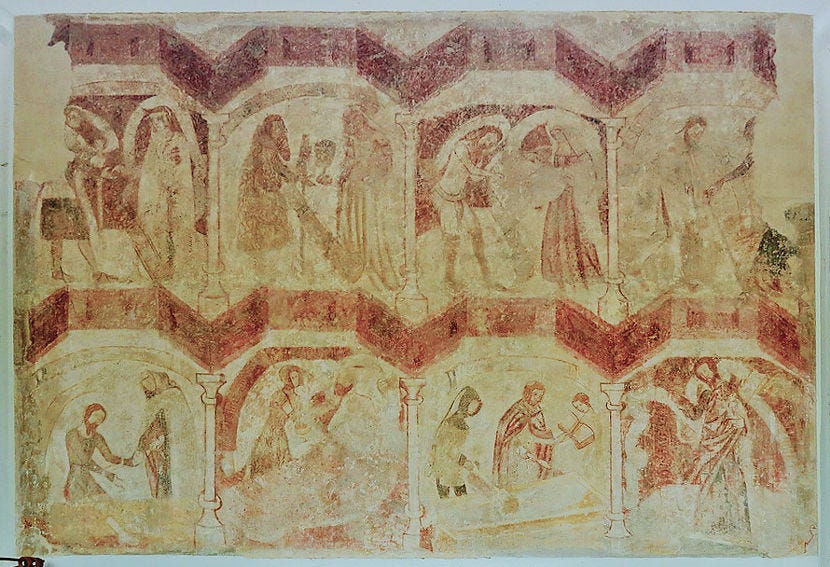
This set is from the fourteenth-century wall paintings at Wickhampton, Norwich. In them, a woman completes the seven works of mercy. Top, from left: Feeding the Hungry, Giving Drink to the Thirsty, Clothing the Naked, Receiving the Stranger
Lower, from left: Visiting the Imprisoned, Visiting the Sick, Burying the Dead.
Then at the end, Christ blesses all the works.
This scene was, like the preached Works of Mercy, quite literally at the center of Christian life, since it was painted on the walls of the parish church, and more metaphorically, at the heart of being a Christian in the Middle Ages. It’s not that they were necessarily performed perfectly or even well, but that the expectation was there. You want to love Jesus? Love your neighbor through these things.
Most of the time, these scenes were depicted separately. I love the version from the Master of Alkmaar that I share in Ask of Old Paths. But there are other interesting versions from later, for instance, Caravaggio’s famous Seven Works of Mercy:
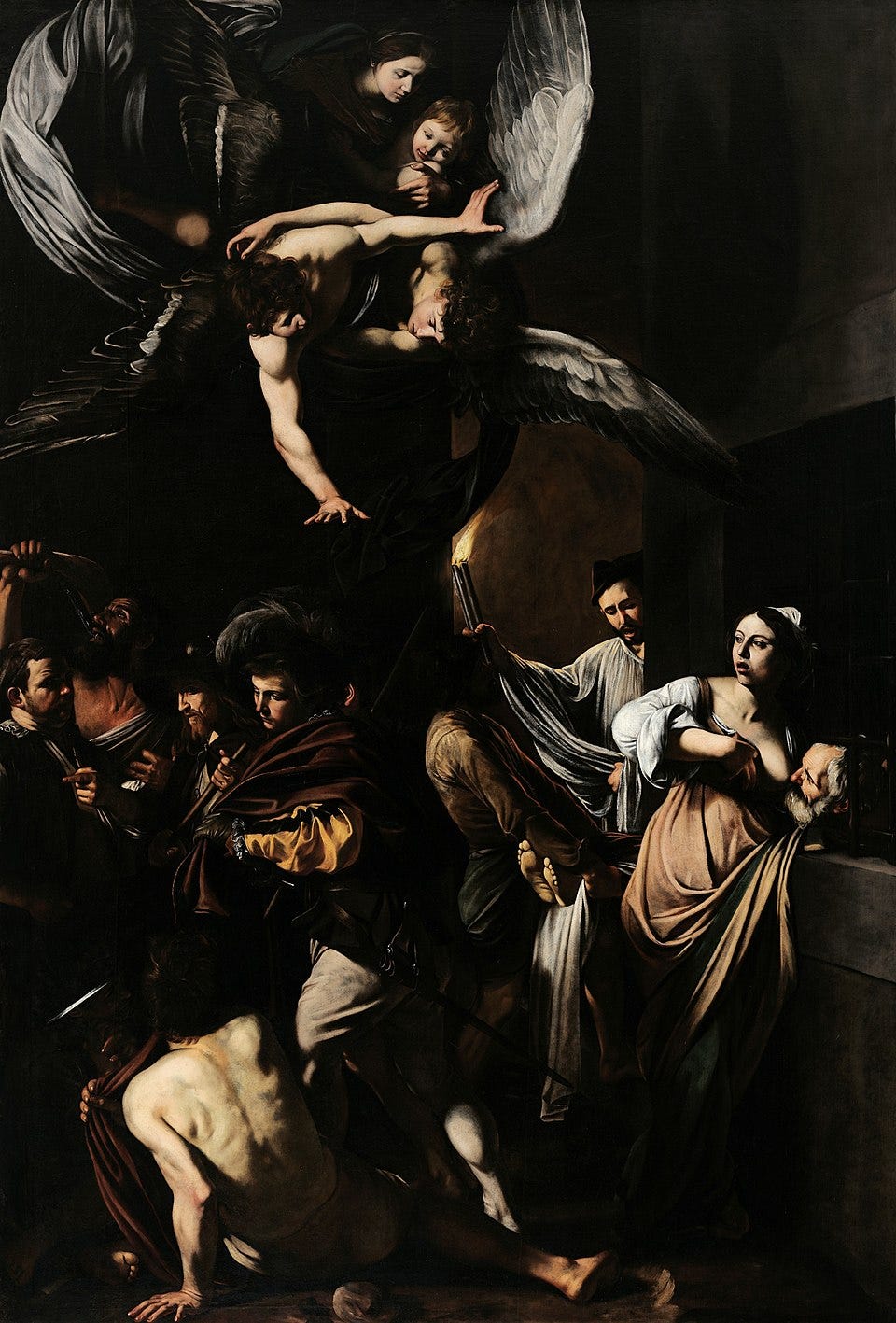
This list mostly stems from Matthew 25:
31 “When the Son of Man comes in his glory and all the angels with him, then he will sit on the throne of his glory. 32 All the nations will be gathered before him, and he will separate people one from another as a shepherd separates the sheep from the goats, 33 and he will put the sheep at his right hand and the goats at the left. 34 Then the king will say to those at his right hand, ‘Come, you who are blessed by my Father, inherit the kingdom prepared for you from the foundation of the world, 35 for I was hungry and you gave me food, I was thirsty and you gave me something to drink, I was a stranger and you welcomed me, 36 I was naked and you gave me clothing, I was sick and you took care of me, I was in prison and you visited me.’ 37 Then the righteous will answer him, ‘Lord, when was it that we saw you hungry and gave you food or thirsty and gave you something to drink? 38 And when was it that we saw you a stranger and welcomed you or naked and gave you clothing? 39 And when was it that we saw you sick or in prison and visited you?’ 40 And the king will answer them, ‘Truly I tell you, just as you did it to one of the least of these brothers and sisters of mine, you did it to me.’ 41 Then he will say to those at his left hand, ‘You who are accursed, depart from me into the eternal fire prepared for the devil and his angels,42 for I was hungry and you gave me no food, I was thirsty and you gave me nothing to drink, 43 I was a stranger and you did not welcome me, naked and you did not give me clothing, sick and in prison and you did not visit me.’ 44 Then they also will answer, ‘Lord, when was it that we saw you hungry or thirsty or a stranger or naked or sick or in prison and did not take care of you?’ 45 Then he will answer them, ‘Truly I tell you, just as you did not do it to one of the least of these, you did not do it to me.’ 46 And these will go away into eternal punishment but the righteous into eternal life.” (Matt. 25:31-46)
This list of actions named by Christ makes up six of the acts. The early church added burying the dead. Sometimes, as in the list I quote in Ask of Old Paths, giving drink to the thirsty is combined with feeding the hungry, and “lending freely without expectation of return” is substituted to make up the seven.
Why does mercy oppose avarice, and not, say, just generosity? If avarice blinds us to true worth, driving us to seek our salvation in dead things and ignore those who truly bear the image of Christ, mercy forms our vision, so that we may see the true presence of Christ in his images. It also helps us to recognize ourselves as needy, too, for each of us have been someone in need of mercy. Ultimately, there are no generous, self-sufficient benefactors in the kingdom of heaven, just fellow receivers of the abundant, overflowing, merciful blood of Christ and the gifts of our neighbors.
So, mercy versus avarice. Timely for this season’s excesses and abundances. I love presents, giving and getting. At my best I am a thoughtful gift-giver and delighted receiver who rejoices in gifts because they say “you thought of me! you know what I love!”; at my worst I am a materialistic slave to capitalism. Both can be true! This feature of my temperament means that I often flail in avarice’s kraken tentacles around this time of year.
I’ve had an idea for a while now, that I just have not put into action. What if I intentionally did the seven works of mercy during this season of temptations to avarice? And what if you did too, if you wanted to?
I have this wonderful imagination of the church in all its different places, in obedience to Christ’s words in Matthew. See me in the needy, witness to my presence through your actions and you shall see me in truth.
So the six weeks up to Christmas, I’ll be posting weekly on Notes and Instagram with a list of suggestions for one particular work of mercy. I’m hoping to include a whole range of ideas, for those who are housebound or chronically ill, who have small children, who might need to get a little bit creative with their time and place. Some of these things many of us already do—caregivers, teachers, nurses, and parents, I see you out there feeding and taking care of the sick and ministering! Equally, I know much on the list requires us to go out of our way, to cultivate our vision and habits of looking for Jesus and his return. And isn’t that the most Advent-y of activities? We wait for him, we seek him like the Magi, we bear him like Mary as we become more like him, as we give birth to love in the world.
Do me a favor. Tell me if you’re going to tag along, maybe even tag me if you do one of the acts. The world often feels very dark, and I’d love to see the all our little candle lights of mercy out in the world this Advent, the hands and feet of Jesus running out to love.
Schedule, if you’re interested (I have combined food and drink to fit the amount of weeks before Christmas):
Feeding the Hungry/Drink to the Thirsty: the week of 11/16
Clothing the Naked: 11/23
Receiving the Stranger: week of 11/30
Comforting the Imprisoned: week of 12/7
Visiting the Sick: week of 12/14
Burying the Dead: week of 12/21
Of course, you don’t have to follow this schedule strictly. You could extend your intentional works of mercy through the Christmas season, or do several in one week. Do what rhythm fits your context. This is merely for the posting of ideas (and I’ll be following that schedule myself).
What I’ve been up to this month:
I spoke on the Annunciation and medieval poetry and art for Awe & Presence, a Living Church conference in St. Louis. Delightful.
Book launch things for Ask of Old Paths! Highlights this month include a review by Nadya Williams, a review for Mockingbird by Victoria Emily Jones and a great interview on Life with God: A Renovare Podcast.
Old Books with Grace is going strong. Fun recent interviews with Lisa Colón DeLay | SparkMyMuse and out tomorrow, Elizabeth Oldfield. Stay tuned for some Advent poetry coming your way in December.
What’s next:
A nice long break from speaking and interviews—but upcoming speaking in the spring includes Michigan, Florida, Colorado Springs, and Houston, so if you’re in one of those locations, keep your eyes peeled for more details.
What I’ve been reading this month:
Nonfiction: Still slowly savoring Richard Foster’s Prayer with a small group. Rich!
Fiction: I was in the mood for a re-read and decided it seemed like Dickens season. I picked up A Tale of Two Cities for the first time in 15 or 20 years. It’s been so fun.
Medieval/Medieval-adjacent: Marian lyric poetry!
Article: I don’t even know what I’ve read lately. Probably some ridiculousness over what color nails are in for late fall (browns and burgundies, for the curious). Nothing to share.
A Prayer from the Past
This month’s prayer is from the evergreen St. Thomas Aquinas (d. 1274), great theologian and thinker and lover of God. It is excerpted from the larger prayer, “For Ordering a Life Wisely,” printed in one of my favorite prayer books, The Aquinas Prayer Book from Sophia Institute Press.
Give to me, O Lord God,
a watchful heart,
which no capricious thought can lure away from You.

Give to me
a noble heart,
which no unworthy desire can debase.

Give to me
a resolute heart,
which no evil intention can divert.

Give to me
a stalwart heart,
which no tribulation can overcome.

Give to me
a temperate heart,
which no violent passion can enslave.

...Amen
Peace for your November,
Grace
P.S. Medievalish is free, and I’d be delighted if you shared it with a friend!

This was an excellent article, one of the best that I have seen on this area. Thanks so much. I was unaware of the way this was portrayed in the churches. Your schedule we will try to work through. I am just genuinely pleased with how you have portrayed this whole area. Practically it is a help. Thank you.
Grace, you give me so much to ponder. I love it! Thank you!